New Book Explores California’s Complicated ‘Tin Can Coast’ Fishing History
The following appears in the July issue of California Sportsman:

In the late 19th and early 20th centuries, the Golden State’s once booming fishing industry started teetering.
The reputation of the area west of Monterey Bay and beyond that’s known as the California Current was once home to countless numbers of valuable sea creatures.
“It was here that 18-century locals encountered frisbee-sized abalone mollusks, sardine schools the size of buses, and yellowfin tuna, each the size of a man. But it was not to last,” states a press release by the debut book of British chef turned fishing historian sleuth Joseph Ogilvy, who was fascinated by the backstory.
From political posturing to shameless racism disguised as conservation measures targeting the many Chinese and Japanese immigrants who made the industry the cash cow it became, Ogivily takes a deep dive into this genre, with the Monterey area becoming fodder for some of the most storied writers of their time.
“Along the way, they became drivers of geopolitical competition, catalysts for the dramatic rise and fall of Cannery Row aristocracy, and even surly muses for John Steinbeck and Fritz Lang,” the press release continued.
The following is excerpted from Tin Can Coast: A History of Industry, Greed and Fishing in the Golden State, published by Bloomsbury Publishing.
book. (KODANI FAMILY/COURTESY OF TIM THOMAS)
BY JOSEPH OGILVY
At the same time that Congress was closing the United States’ borders to China, a new offensive was opened against the Golden State’s Chinese fishers, its battleground the inlets and rock pools of the California Current.
In throwing out the anti-Chinese fishing ban in 1880, Judge Sawyer wrote that the act was clearly “not passed in pursuance of any public policy relating to the fisheries of the state . . . but simply as a means of carrying out its policy of excluding the Chinese from the state.” Future legislation against the Chinese fishers would have to find a fig leaf with which to disguise its efforts.
That fig leaf was conservation. A raft of so-called conservation laws, among the first the state ever passed, directly targeted Chinese fishers. The Chinese had long since become the default explanation for anything awry in California’s promised land, and now the Italian shrimpers, beaten out on price by Chinese competitors, and the European-American salmon industry, facing declining catches, were particularly vociferous in their calls for environmental regulation.
In the mid-19th century, say, to a 49er pitchforking salmon from the banks of a Sierra stream or a homesteader passing great rivers of buffalo on the Great Plains, the idea of conservation would have made little sense in the face of America’s apparently endless frontier. But over the last third of the 19th century, it had become clear that the New World’s bounty was indeed being squeezed dry. Salmon runs in California and New England were visibly failing, as were the passenger pigeon flocks and the bison herds and the big game animals pursued by gentleman hunters. The California redwood groves and New England hardwood forests were being felled and thinned.
Slowly, stirrings of Anglo-American elite environmentalism began to be felt. In 1875, Yellowstone had been declared a national park, then Sequoia and Yosemite in 1890. In 1889, Theodore Roosevelt founded the Boone and Crockett Club, an association of avid big game hunters that agitated against the unconstrained slaughter of their preferred prey (at least by the commercial hunters they considered unsporting). The Sierra Club followed a few years later.
The disappearance of abundant American species like the buffalo was in various nebulous ways tied to fears over the national character. Sometimes the fear was that America’s white men would have nothing to test themselves against, no wild nature to strengthen their spirits; sometimes, that a proud and noble American race like the redwood was being supplanted by “invasive species” or exploited to extinction by undesirables.
YEARS EARLIER, IN 1870, the same movement had inspired creation of the California State Board of Fish Commissioners (later the California Fish and Game Commission). It was one of the first state conservation agencies in the country, founded at the behest of wealthy white anglers who simultaneously feared depletion of California’s sporting species and wished to challenge themselves against classic angler’s prey from back East.
At the start, the commission mainly concerned itself with artificially hatching salmon and deliberately introducing foreign species to California’s rivers. As Italian shrimpers and salmon packers began to make noise about so-called Chinese depredations, the commission expanded its purview. They launched a campaign to regulate Chinese fishers in the state, proposing and enforcing a series of laws and regulations to control their harvest. It was the first, and for a long time the only, attempt to seriously limit an active fishery in California. The campaign was motivated by racial resentment, but the attack helped secure more funding for the commission and more public support for the conservation movement, at least among European-Americans.
Of course, the commission’s logic had holes. According to its 1883 report on California’s fisheries, “The oft-repeated and serious complaint that fish food is becoming scarce in California furnishes a powerful reason why the Chinese exhaustion should cease and the cause of the complaint be removed.” Yet the commissioners seemed unsure of how much of an impact the Chinese fishers were having. In the bad years, when catches were low, the commission ascertained that “the diminution was largely owing to the violation of the fish laws by [the] Chinese and others,” but after one good period the commission reported that “during the last two years – notwithstanding the heavy drain made upon our waters by hordes of alien fishermen, using criminal methods and for foreign deportation – the catch of most of the food fishes has been measurably satisfactory.”
Regardless, the agency’s claim that it was the only thing protecting California’s natural bounty from being ravished paid dividends. Its frequent petitions to the state legislature for more funds and more power to put a stop to “the Chinese exhaustion” were consistently successful. In 1883, the agency won the power to make arrests. One hundred and fifty were made in the first two years, and more than six in the next. Then in 1885, it was afforded $4,000 to buy a patrol steamer. In 1891, it requested at least $20,000 to protect the state’s waters; it received $27,500.

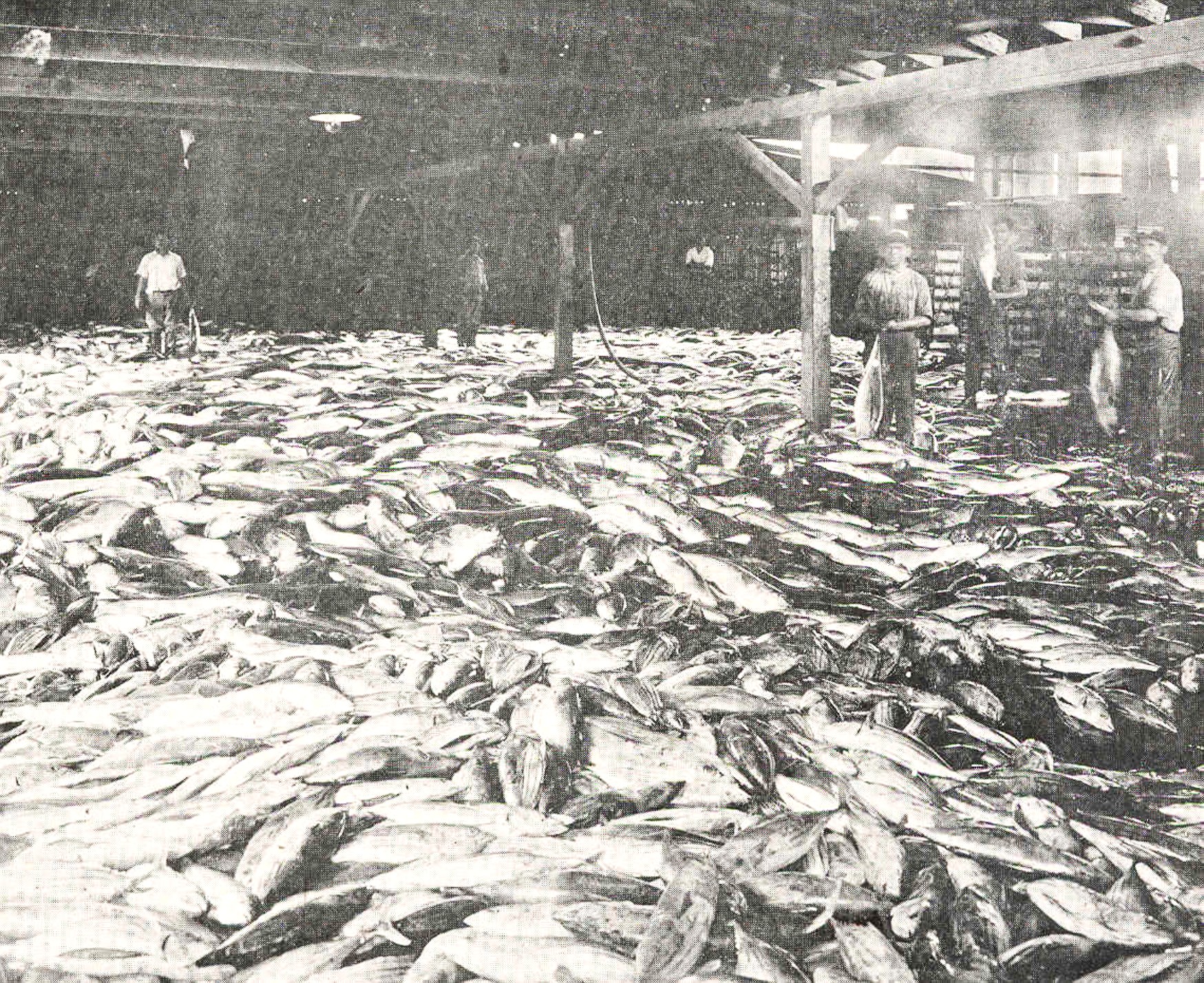
(PHOTOGRAPHER UNKNOWN/COURTEY OF THE SECURITY PACIFIC NATIONAL BANK COLLECTION, LOS ANGELES PUBLIC LIBRARY).
AS THE COMMISSIONERS REQUESTED and received more money and more influence, they moved to provide more scientific justification for their activities. Assistance was readily forthcoming. David Starr Jordan, the first president of Stanford University, was California’s foremost ichthyologist, its foremost education administrator, and among its foremost public intellectuals. He was energetic and confident, with bulging eyes and a passion for football and race science.
His study of Darwin’s theory of natural selection and the evolution of fish led smoothly into social Darwinism and the apparent evolution of different human races, while social Darwinism led smoothly into his work as a university administrator, shaping the future of the American race through the education of its youth. The titles of his many books traced the connections in his thinking, from The Fish Fauna of the California Tertiary, via The Blood of the Nation: A Study in the Decay of Races, through Survival of the Unfit, to College and the Man: An Address to American Youth.
Before he came to Stanford, Jordan had been dispatched by the U.S. government to prepare the first survey of California’s fish and fisheries. In his 1880 report Jordan explained in an oxymoron that “there are no authentic accounts of the productiveness of the past fisheries of this county. There is no doubt that the number of fishes in San Diego Bay has been greatly reduced by the constant use of fine-meshed seines by the Chinamen.”
Later he explained that the “Chinese methods of fishing are undoubtedly extremely destructive,” but rather than studying their apparent effects, he simply reprinted a letter from the Italian Fishermen’s Union complaining to their state senator about the “wanton destruction” committed by their competition.
Jordan was an ardent conservationist, a founding member of the Sierra Club and a true believer in the uplifting power of California’s great outdoors to refine the body, mind, and soul – at least those of the “strong races” who “know the meaning of freedom.” Preserving the beauty and abundance of the Golden State, for him, was closely tied up in the control and exclusion of hereditary unfitness from its shores. Only a few years after the fish survey, while he was living in the Midwest and serving as president of Indiana University, Jordan had become an early and fervent proponent of the new “science” of eugenics. The transmission of desirable or undesirable traits as an organizing principle for society and history satisfied his taxonomist’s brain, while the attempt to improve upon nature, to improve upon the wasteful slowness of natural selection, meshed with his vision of himself as an educator, shaping and improving the youth of the “American race.”

Jordan did indeed mold California’s youth for years to come. Once he became Stanford’s first president in 1885, he worked to build the university into a center of marine science on the West Coast, founding the Hopkins Marine Station, where he personally trained many of the scientists who would go on to shape ocean conservation science in the coming decades. Among them was N. B. Scofield, a member of Stanford’s very first graduating class of 1895. Jordan recommended his former student to the Fish and Game Commission, where in the words of Arthur F. McEvoy, author of The Fisherman’s Problem, a seminal book on the law and history of California’s fisheries, Scofield continued his mentor’s attacks on the Chinese fishers in “a series of reports laced with the virulent anti-Chinese rhetoric that was common currency in late 19th-century California,” insisting that “up to half of the shrimper’s catch consisted of smelt and other small fish which were fodder and fry for other fisheries, rather than shrimp.” The reports were reprinted in biennial report after biennial report, providing scientific justification and encouragement for the anti-Chinese conservation laws.
Yet Scofield’s interest in conserving California’s natural resources was genuine too. In later years he would correctly predict the sardine’s collapse and fight to prevent it. But his vision was clouded, as was Jordan’s. For both men, as McEvoy describes, “the nearly universal frustration with the shrimp and abalone fisheries . . . substituted for observation and reasoned analysis of fishery problems.” That it dovetailed with Jordan’s theories of eugenics and racial purity likely didn’t hurt. The state of fisheries knowledge, as scientists would occasionally admit, was incredibly sparse. That didn’t stop them from confidently blaming the Chinese shrimp fishers. The drop in catches was real. It just had little to do with Chinese shrimp nets and a lot to do with environmental conditions, including the pollution of the Sacramento and San Joaquin Rivers from mining in the hills, as some less hate-blinded observers at the time recognized.

Pop” Doelter, a pioneering chef nicknamed the “Abalone King,” stands amid shells at Monterey.“The abalone fishery began as a kind of refuge
for the Chinese and then Japanese immigrants in the state,” says Ogilvy. “But as time went on and racism squeezed the original fishers, it became
a kind of emblem of California beach culture, a bridge between the world of surfing and the state’s commercial fisheries.” (PHOTOGRAPHER UNKNOWN/ COURTESY OF THE PAT SANDS COLLECTION)
THE GROWING ROLES OF both Jordan and Scofield in the commission reflected a broader shift in the Progressive Era conservation movement, from gentleman outdoorsmen worried about their disappearing game to technocratic conservationists seeking to optimize the nation’s renewable resources through efficiency. Theodore Roosevelt went from founding a hunting club that carefully logged its kills to founding the National Forest Service, dedicated to managing and improving the nation’s woodlands, including for commercial use. The new conservationism was focused on rational use, for current and future generations, as directed by scientifically trained government experts. These new technocrats followed the doctrine of what would later be called “maximum sustainable yield” (MSY): harvesting as much as possible without depleting the base stock of the resource. It encouraged a utilitarian approach to ecological management that broke the natural world down into what it hoped were manageable, analyzable steps with simple fixes that could be easily enacted. Ecology as engineering.

Waste was the great enemy. Waste of future opportunity as well as current resources. Profit-blinded monopolies were wasteful, as were ignorant immigrant fishers. Clear-cutting forests was foolish; so was overharvesting fish fry, apparently. Even nature itself was wasteful: The Board of Fish Commissioners was obsessed with “the destruction of fish by seals and sea lions” who “sit at the entrance of the Golden Gate as royal toll gatherers, and take the lion’s share of the finny tribe, as they pass from the broad Pacific to the Bay of San Francisco.” The overwhelming mortality rate of salmon eggs was wasteful; artificial hatcheries were seen, incorrectly, as far more efficient. Even natural selection was inefficient, too slow to remove “undesirable traits,” at least to Jordan. His theories on eugenics were taken up by the California legislature, which in 1909 passed a law allowing enforced sterilization of the “unfit.”
At the heart of the movement was a confidence in the human capacity to control and improve upon nature, a confidence recently won that would soon be found unwarranted. Far too many simplifications and assumptions were built on it. Meanwhile this kind of condensed, simplified use of power, of government technocrats finding and enacting solutions, made for a perfect weapon.
Editor’s note: Order Joseph Ogilvy’s Tin Can Coast at bloomsbury.com/us/tin-can-coast-9781639736812.

in,” says British former chef Joseph Ogilvy, who wrote Tin Can Coast about the colored and complicated history of the fishery around the Monterey Bay area and the rest of coastal California. (TIN CAN COAST)
Sidebar Q&A WITH FIRST-TIME AUTHOR JOSEPH OGILVY
We chatted with Tin Can Coast author Joseph Ogilvy about what inspired his adventure from the kitchens of Great Britain to a deep dive into California fishing history.
Chris Cocoles Congratulations on a great book, Joseph. What prompted you to pursue this project?
Joseph Ogilvy Honestly, I found the story so interesting and dramatic that it just dragged me in. It began when I came across a brief mention of the California sardine fishery while reading that piqued my interest, so I started reading more about the state’s fisheries, and then it really just snowballed from there. The more I read about it, the more I thought someone should bring all of this together into a book and eventually I figured, why not me?
CC This was your first book. What kind of challenges did that entail?
JO Where to start!? I didn’t go to school for writing or work in journalism before I began the book, so I was really learning how to do everything for the first time. It was exciting, but the learning curve was pretty much vertical. I was working as a chef in restaurants the whole time I was working on the book, so the other big challenge was finding time to research and write.
CC What was your early introduction to fishing?
JO My dad is from Scotland, on the edge of the Highlands, so he used to take me and my brothers fly fishing on a little river that flowed down from the glens [Scottish valleys] near our family home. It was fairly slapdash and almost completely unsuccessful, but great fun.
CC After your graduation from Oxford University, you spent a lot of your career as a chef in the United Kingdom at top-notch restaurants, and it sounds like all the fish you prepared back then influenced your fascination with the industry. What was that epiphany like for you?

JO Part of my job, especially earlier in my career as a chef, was prepping all the fish that came in each day. We’d get 15 pounds of squid, 20 John Dory and a crate full of sardines, and I had to get them all cleaned and ready for service. And then the same the next day, and the same the day after that, and so on. After gutting 500 mackerel or 1,000 sardines, it’s hard not to wonder, “What’s going on with all these fish? Where do they come from?” I think that really set me up to start thinking about what an industrial-scale fishery actually means.
CC Did you have any California connections prior to this book? And what was it like to take such a deep dive into the state’s fishing culture?
JO Not too many. I’d spent some time out there before starting the book. Seeing the Pacific for the first time at Moss Landing there before starting the book. Seeing the was very important for me, and I had loved Cannery Row ever since my mum gave it to me as a kid. But beyond that it was really the drama and appeal of the subject that got me hooked. One of the great things about writing about Californian fishing culture in particular is that so many smart people have been studying and thinking about fishing in the state, so there’s a huge amount of knowledge and analysis to work with.
CC The basis of the book is to explore what’s known as the “California Current.” Can you explain a little about its importance, the fish that swim in it and the commercial and sportfishing industries that rely on it?
JO The California Current is one of the most productive stretches of water on the planet. It’s one of a few eastern boundary currents in the world, all of which are marked by these enormously rich, very unique ecosystems, and California’s full of species that you really can’t find anywhere else. Until very recently, the Current’s been at the heart of California’s story; it seems the first inhabitants of the Americas followed the Current into the new land, the native Californians built complex and fascinating cultures on it, and coming into more recent history, many of the communities that shaped the state were found- ed on fishing – from the Portuguese in San Diego, to Italians in Monterey, to Japanese in Los Angeles and the Chinese in the Bay.
My favorite example is that the Seal of L.A. County, like its coat of arms, which you see on official buildings and so on, still includes a tuna, a little throwback to the city’s mostly forgotten canning past.
CC Can you sum up the complicated California fishing industry history this book tackles?
JO It’s a big story to sum up, but I think the thing that jumps out to me is the missed chances to keep the industry sustainable. So often a group or an industry had a chance to build a fishery that could last, and so often that chance was missed, often through bad luck or ignorance more than anything else.
CC You spent a lot of time in your research for the book with California sportfishing boat crews. What was that experience like and what did you learn from those folks?
JO It was really great. Everyone I spoke to was hugely knowledgeable and helpful. I’d particularly like to thank Frank Ursitti from H&M Landing (hmlanding.com), who was an incredible source of knowledge on San Diego sportfishing.
CC Tell me about what you learned about the racist overtones of the eras you wrote about, especially with the issues that Chinese and Japanese fishers faced back then.
JO The first thing I learned was the shocking breadth and depth of anti-Chinese and-Japanese racism on the West Coast. Coming from the UK, a lot of that history was new to me. Beyond that it was very interesting to me to see how much that racism had shaped the history of conservation and fisheries management in the state and beyond – a lot of California’s early fishing regulations were veiled ways of excluding Chinese and Japanese communities from the fisheries, and a lot of public acceptance (to the forerunner of today’s California Department of Fish and Wildlife) came as a result of that campaign. The other surprising lesson was how impressively resilient those communities were in the face of the hatred – how they continued to flourish despite it – often depending on the ocean as a refuge from the discrimination.
CC The book really focused on three specific fish species: abalone, sardines and tuna. How did those fish shape the state’s fishing industry over time?
JO Each one played a very unique role in California’s fishing history. The abalone fishery began as a kind of refuge for the Chinese and then Japanese immigrants in the state, but as time went on and racism squeezed the original fishers, it became a kind of emblem of California beach culture, a bridge between the world of surfing and the state’s commercial fisheries. Sardines really epitomized the true industrialization of fishing on the West Coast, and their disappearance marked the beginning of its end – whereas the story of the commercial tuna fishery really is the move out of Californian waters, which indirectly but inevitably brought about the end of large-scale industrial fishing in the state.
CC You also get into salmon fishing a little bit in the book. How frustrating was it from your perspective to see so many salmon runs crashing in California, which cost a couple fishing seasons in recent years and a lot of anger from the fishing community?
JO It’s a real shame; I didn’t get into the salmon fishery so much, but one of the big themes of the book is how often the same mistakes get made with fisheries and also how so often ecological problems rebound onto the human communities onshore.
CC Do you have a favorite tidbit that you learned over the course of writing this book?
JO My favorite (probably apocryphal) story is one told by Max Miller, who wrote a brilliant book about his time reporting on the San Diego Harbor in the 1930s called I Cover the Waterfront. He writes in reverential, almost awestruck tones about a fisherman who claims he can hear and locate sardines through the vibrations in the boat’s deck.

simple level he’s a great source for descriptions of the region,” he says of Steinbeck. “But also the influence of his actual writing style was definitely very present in my mind as I wrote.” (WIKIMEDIA)
CC You focused a lot of attention on Monterey Bay. How much were you inspired/ influenced by some of John Steinbeck’s work in that region, and did you channel a little bit of Steinbeck in your research?
JO Hugely. On a simple level he’s a great source for descriptions of the region, from the fishing boats to the inhabitants of the rockpools. But also the influence of his actual writing style was definitely very present in my mind as I wrote, and I think his perspective on society – the way he observes the strange behavior of his characters in this kind of open, honest way – was very inspiring. CS