Locking In Oroville’s Landlocked King Salmon
The following appears in the August issue of California Sportsman:

By Mark Fong
I have a general rule when it comes to fishing on summer holiday weekends: I don’t go.
Yet, when Brett Brady of Bare Bones Guide Service told me that on a string of recent trips to Lake Oroville, he and his clients had hooked up with three big landlocked king salmon that he estimated to be near double digits, it was all the convincing I needed to jump on board.
Lake Oroville’s landlocked kings are managed as a “put and grow” fishery. As the fish are triploids, or sterile, and do not reproduce, the fishery is dependent on stocking by the California Department of Fish and Wildlife. Fish are planted when they are 2 to 3 inches in length and typically reach catchable size by year two.
“This season is probably the best year I have seen for fish that were planted as 2- to 3-inch fingerlings,” Brady says. “The majority of the fish we are catching are 2-year-olds that are about 2 to 3 pounds with some bigger, older fish mixed in as well. The fish have an incredible growth rate; they can grow an inch a month when they are on good food (pond smelt). They are just eating machines; next year we should see some really nice fish in the 5- to 7-pound range, and the following year a 4-year-old fish can weigh between 8 and 12 pounds.”
THE NEW NORMAL
It was very early on the final morning of the July 4 weekend when I arrived at the Loaf Creek Boat Ramp. There I met up with Brady and his clients for the day, Larry Armstrong and Jeff Armstrong (no relation). Both Larry and Jeff are experienced fishermen who were eager to learn about fishing for Oroville kings and to catch a few fish along the way. After making introductions, we loaded our gear in Brady’s boat and headed for the launch.
Before Brady was allowed to put his Rogue Jet boat in the water, he proceeded to an area near the launch ramp where workers validated and removed the wired-on blue inspection tag attached to his trailer and boat. In order to receive the inspection tag, Brady’s trailer and boat were previously subjected to a mandatory inspection and decontamination process. All of this is a part of the watercraft inspection process initiated by the California Department of Water Resources to prevent the spread of the invasive golden mussel. (To learn more about the boating restrictions on Lake Oroville, please visit the California Department of Water Resource’s website at water.ca.gov for the latest information.)
DAWN PATROL
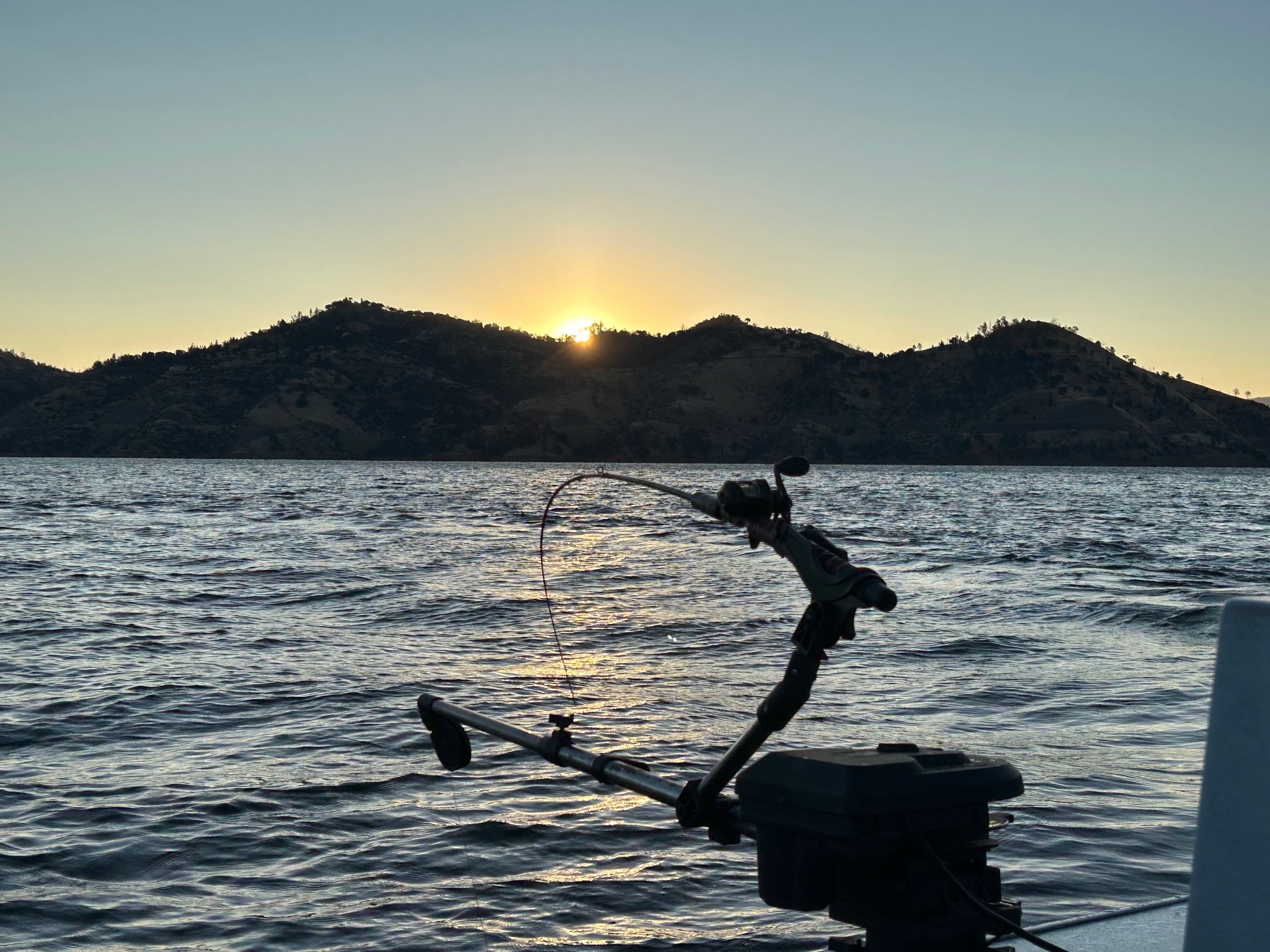
For an apex predator like the landlocked king, low light conditions play right into their wheelhouse. Add in some wind and you have the recipe for a feeding frenzy. With the sun still behind the eastern foothills, Brady made a quick run to a long-sloping point that stretched far out into the main body of the lake, knowing full well that the day’s initial bite window was waning as the sky grew brighter.
Stopping short of the point, he slowed the boat to idle speed while watching his electronics for signs of activity. Almost instantly Brady spied large swarms of pond smelt with some salmon mixed in suspended between 65 and 85 feet deep. He wasted little time deploying the downriggers and setting out the lines.
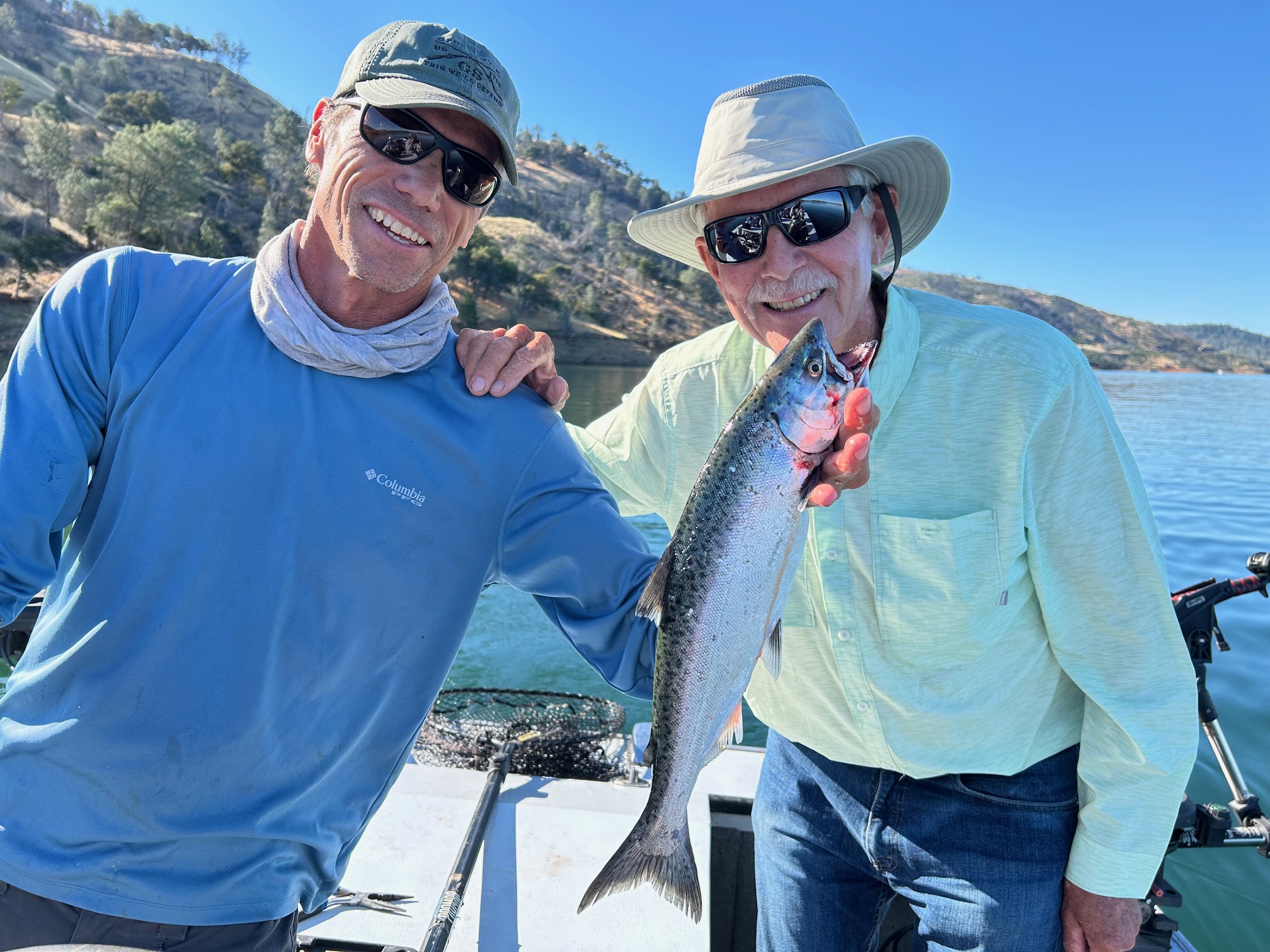
As we moved along the structure, Brady varied the trolling speed between 2 and 2.5 miles per hour. Just as the boat sped up, the left rear rod went off. Jeff rushed to the back of the boat and quickly removed the rod from the rod holder. With a short, forceful upward snap of the rod, he released the line from the downrigger clip and the fight was on. After a few spirited runs, Jeff had the fish within range of the net, and with one motion Brady scooped up the silvery king. A few pics later, we released the salmon to fight another day.
“I like to change it up,” explained Brady. “I don’t keep the same speed or troll in a straight line. I’ll throw a turn, or speed up, or slow down. I like to change up the cadence of the lures; that’s how you generate strikes. I’ll target structure too – stuff like sharp drop-offs, rockpiles or points, because that is where the bait is. The salmon may not be in the structure, but they will relate to it because of the bait.”
FISH ON … AGAIN!
Even before Brady was able to reset the rod, a salmon struck the right rear rig. This time it was Larry’s turn to hook up. The fish made a powerful initial run, but unfortunately it came unbuttoned before Larry could get it near the boat. Within a few minutes the rod went off again; then it was my turn. As salmon are strong battlers, on light tackle I enjoyed the fight before bringing the fish boat-side, where Brady reached over the gunnel and released it. We were on a roll and then, like a light switch, the bite just turned off.
“Salmon bite in spurts,” Brady concluded. “The key to finding the salmon is finding the bait; you just gotta have bait. The will fish move in and out of the pond smelt. They will go on in and gobble up, digest and then they’ll come back in and do it again. That’s their cycle.”

ON THE MOVE
Brady continued to work the area for a while longer, but with no bites he opted to run to a new spot near the spillway. With the gear deployed, we trolled along the edge of an underwater shelf. The bait was present, and like clockwork the salmon bit again. This time Larry’s luck was better; he put the first fish in the boat. Two more passes gave up several more fish, and then like that the bite stopped and it was time to move again.
Our next destination was a stretch of water near the Bidwell Bar Bridge, a well-known salmon hangout. With the gear in the water, it did not take long for the action to begin. Unfortunately for us, none of the fish stayed stuck. After several missed opportunities, we finally got a fish to the boat. To our surprise it was a fat and healthy spotted bass. It wasn’t quite what we were looking for, but a fun bonus nonetheless.
Over the next few hours, we were able to hook up and release a handful of kings along with several more spotted bass and a rainbow trout. It turned out to be quite the mixed bag.
THOUGHTS ON GEAR
While there are many options when it comes to trolling for landlocked kings, Brady employs a simple, well-dialed system that he has perfected over many seasons on the water.
“I like to use a 5.5-inch teardrop dodger followed by an 18-inch leader of 15-pound fluorocarbon line tied to a 1.5- to 3-inch hoochie,” he said. “I have had really good success with RB Tackle dodgers and hoochies (rbtackle.com), which are locally made. As far as hoochies (go), greens and whites are some of my best colors, but pink and chartreuse can be good too. You’ll want to have three to four colors available so you can rotate through them to find what is working best that day.”
When it comes to the all-important trolling rod, Brady worked with Prolite Rod Technology (proliterods.com) to design the 7-foot, 10-inch BBPSDR710L-C Bare Bones Pro Series trolling rod.
“These salmon can be big, so your typical kokanee rod can be underpowered,” Brady says. “If you hook into a good salmon, you are gonna want something that has a little backbone, and this rod is perfect.”
Finally, Brady spools up a small levelwind reel with 15-pound monofilament to complete his setup.
While we did not get into any of the big salmon that Brady had encountered in recent outings, we did catch and release a variety of nice fish, along with receiving a true masterclass in trolling for landlocked kings. CS
Editor’s note: To book a trip with Brett Brady or to learn more, please visit his website at fishbarebones.com, follow him on Facebook at Bare Bones Guide Service, or contact him directly at (530) 263-4451.