How Bassers Can Cheer Up From The Postspawn Blues
The following appears in the June issue of California Sportsman:

By Mark Fong
If you are a bass fisherman, you know the highs and lows of springtime bassing.
First comes the prespawn, which is definitely the best time of year to catch the biggest fish of the year. Next comes the spawn, when it seems that every bass in the lake is in 5 feet of water – or less – and ready to strike your bait. Once the spawn is complete, it’s time for the dreaded postspawn blues. Bass are tired and stressed from the rigors of spawning and can be very difficult to catch, but as time progresses and the fish have had time to recuperate, they will eventually come out of their funk.
WHERE TO GO
Once the bass have finished their reproductive duties, they begin a journey to their summer haunts. Just as the fish migrated from deep water to the shallows to spawn, they will return to lower depths and take the same migration routes they followed during the prespawn, but this time in reverse.
Fish tend to group up in predictable locations during the prespawn migration, making them easier to locate. Unfortunately, during postspawn the fish don’t behave the same; instead, they have a tendency to scatter.
Good places to start searching include secondary points just outside of spawning coves and flats. Look for any structure on the points such as weedlines, stumps, trees, rockpiles or docks.
As time goes on, bass continue moving back towards the main lake. When this occurs, main lake points and offshore structure are good places to check.
WHAT TO DO
On lakes with shad as a forage base, the shad spawn typically occurs during the same time period as the bass postspawn, which can supercharge an otherwise tough bite.

Shad typically spawn during low-light conditions, meaning that it can be over after the first hour of daylight.
And not all bass spawn at the same time. This is especially true of the three major species. Spotted bass and smallmouth will spawn earlier when the water is cooler, followed by largemouth when the water warms even more. What this means is that even though the spots and smallies may be in postspawn mode and difficult to catch, largies may still be on their way to their spawning locations and in a much more agreeable mood to bite.
In addition, the spawn can occur at different times for different locations on a given lake, so keep this in mind as well. Because the fish are scattered, it pays to cover a lot of water. At the same time, because the fish are negative, it is important to fish a variety of baits.

WHAT TO THROW
If I am lucky enough to find an active shad spawn, my first bait choice is always a topwater lure. My favorites include a walk-the-dog-style bait, a popper or a wakebait. If the bass won’t respond to a topwater, then a swimbait such as a Yamamoto Baits Shad Shape Swimmer or a Shibo Swimmer fished on a ballhead jig is a good option.
If the fish are in no mood to eat a moving bait, then it is time to slow down and grind it out. When the fish are in less than 10 feet of water, I always like to throw a wacky-rigged 5-inch Senko. If they are deeper than that, I’ll instead opt for a 6-inch Roboworm fished on a drop-shot rig.
PUTTING THE THEORY TO PRACTICE
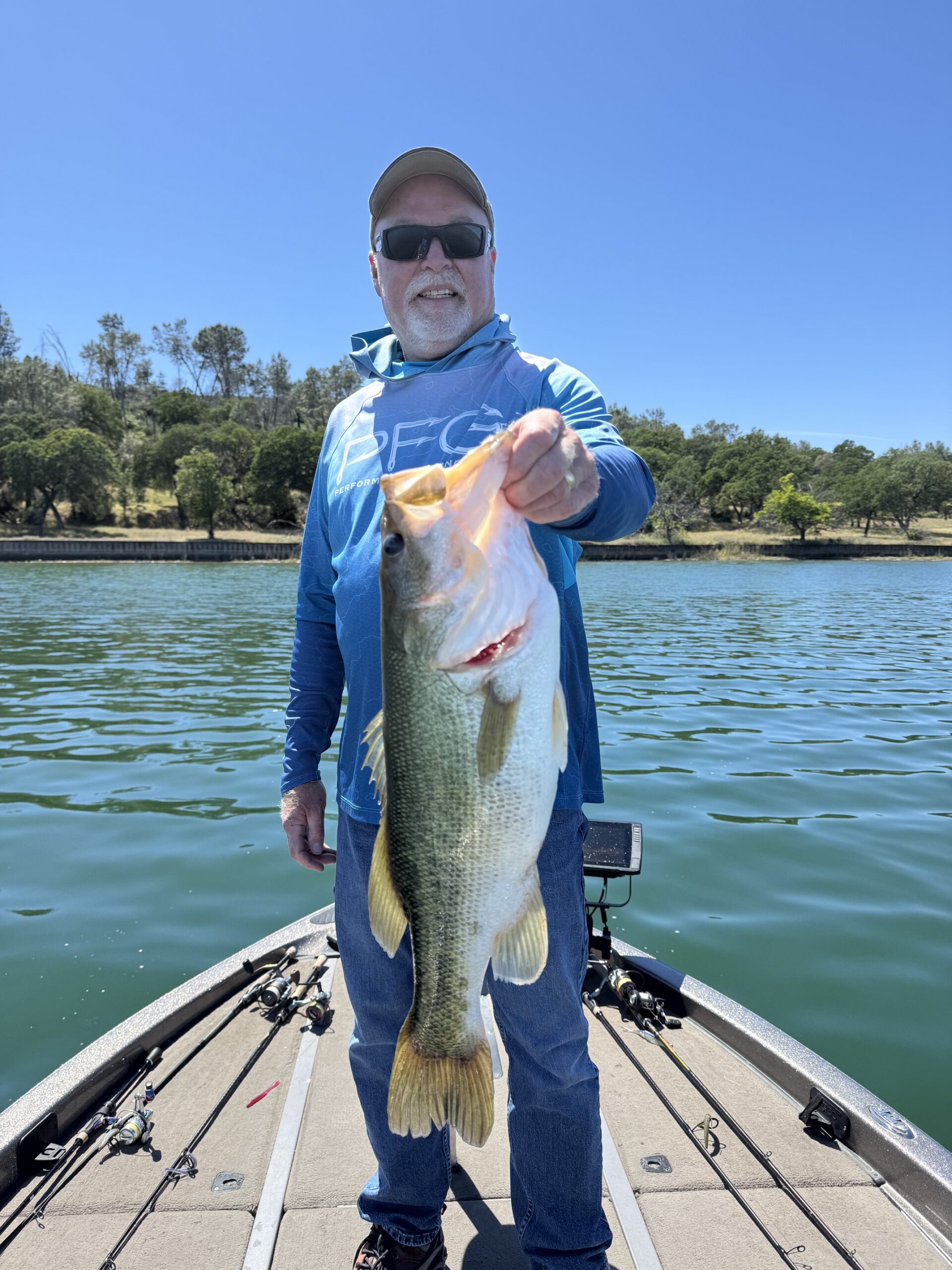
Recently, fishing buddy Paul Parks and myself made a trip to Lake Berryessa. With the water temps in the mid-70s and the calendar settling on the middle of May, it did not take long to figure out that the majority of fish in the lake were in the postspawn stage.
We started out fishing near a well-known spawning area in the south end of the lake. We caught quite a few spent female bass with big heads and skinny bodies on Baby Bass Senkos and Roboworm drop-shot worms in morning dawn. That was the first clue that the fish in this area were definitely of the postspawn variety.
We ran around the lake looking for something different but found more of the same. The fish were definitely scattered. We’d catch one here and a few there, but nothing grouped up. We came across just two areas with fish chasing bait, so the shad spawn really did not play for us. There were zero topwater fish, as they were definitely not in the mood to chase down a moving bait.
But we stuck to it and just kept grinding. At the end of the day, we ended with some nice, quality fish – albeit spawned out – and a fair number of them as well. It just goes to show that with knowledge and some perseverance, the postspawn blues can be overcome. CS