Hoopa Valley Tribe, CDFW Collaborate On Trinity River Fish Restoration Project
The following is joint press release from the Hoopa Valley Tribe and California Department of Fish and Wildlife:
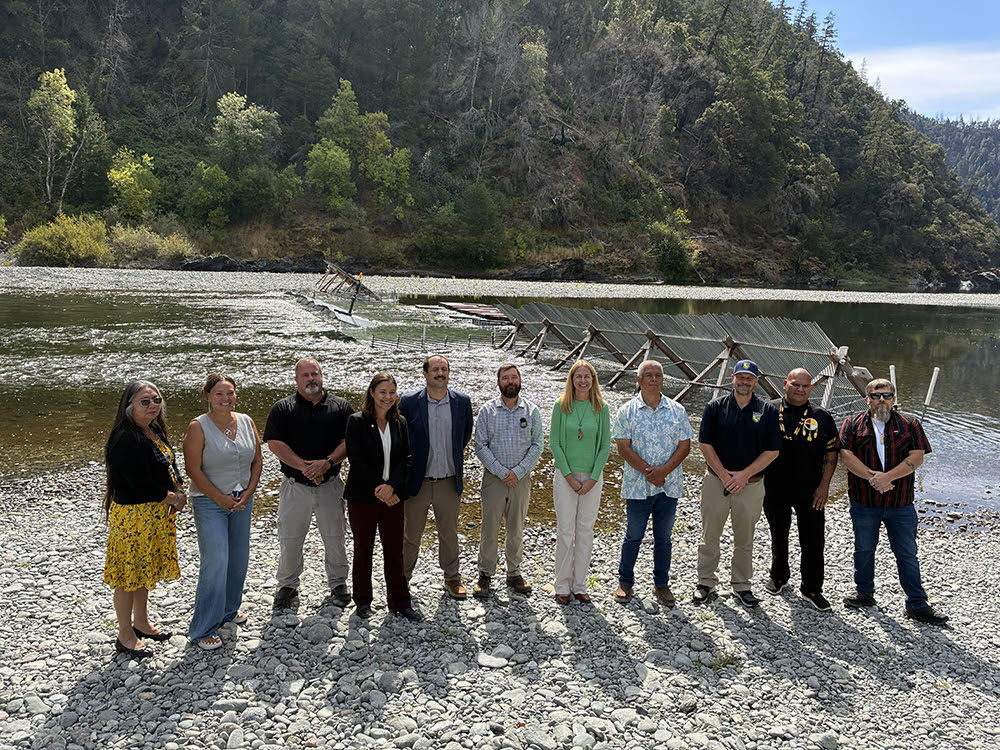
Hoopa Valley Tribe and California Department of Fish and Wildlife Announce Historic Fishery Restoration Partnership
HOOPA, Calif. — The Hoopa Valley Tribe (Tribe) and the California Department of Fish and Wildlife (CDFW) are thrilled to announce a historic project that advances tribal Traditional Ecological Knowledge (TEK) and sustainable fishing with CDFW scientific monitoring — improving the health of salmon populations, supporting tribal practices and advancing the science that drives fishery management. The Tribe and CDFW have incorporated a selective harvest program into the Trinity River Restoration Program that along with other benefits, will foster Tribal harvest opportunities that are vital to the Tribe’s culture, community and economy.
The centerpiece of the program is a weir in the Lower Trinity River on the Hoopa Valley Reservation that temporarily contains fish for both scientific examination and selective tribal harvest. The weir replaces two other weirs that the Tribe and CDFW had been operating independently at different sites on the river.
Since 1978, the CDFW Willow Creek Weir has provided critical information used to evaluate long-term salmon and steelhead population trends including annual run size estimation, species composition, age structure, hatchery composition and migration timing.
Since 2016, the Tribe’s Selective Fish Harvest Weir downstream of the Willow Creek Weir near Hoopa has supported those monitoring efforts while also providing opportunities for selective harvest and the distribution of salmonids for Tribal ceremonial, subsistence and community use.
The Tribe’s weir is based upon traditional fish harvest methods that the Hupa people have practiced since time immemorial. The Tribe’s modern weir design reflects centuries-old conservation principles that protect important genetic attributes of “natural reproducing fish populations” by use of selective harvest techniques. Through operations coordinated with CDFW, the Tribe will continue to harvest fish in accordance with established fishery management objectives while allowing the remaining fish to continue unimpaired upstream to spawning grounds.
Beginning this season, both monitoring and selective tribal harvest will be consolidated at the Tribe’s on-reservation weir. Combined tribal and state personnel, equipment and field operations will improve coordination between agencies, and make more effective use of available funding and staffing resources. Significantly, replacing two separate weir operations with a single facility will improve passage and in-river survival by reducing the number of times fish encounter in-river infrastructure and handling operations, while still providing needed information for effective fisheries monitoring and management.
“This partnership demonstrates how Tribal and state agencies can work together to achieve multiple resource management goals,” said CDFW Director Meghan Hertel. “I’m incredibly proud of the hard work by our Tribal partners and CDFW staff that led us to this historic accomplishment.”
The collaborative program also strengthens the longstanding government-to-government relationship between the Hoopa Valley Tribe and the state of California. Through shared staffing, standardized monitoring protocols, joint training and coordinated decision-making, both agencies are building a model for cooperative fisheries management that balances conservation, scientific monitoring and Tribal resource stewardship.
“By combining our monitoring programs and selective harvest into a single operation, we are improving efficiency, reducing impacts to migrating fish, strengthening the scientific foundation of fisheries management and continuing to support the cultural, subsistence, and economic needs of the Hupa people,” said Hoopa Valley Tribal Chairman Joe Davis.
The consolidated weir has been installed near the Tish Tang Campground on the Hoopa Valley Reservation in anticipation of the upcoming fall fish migration season.