A Week Out From Spring Turkey Season: A Gobbler Hunter On Getting Outside Again
The following appears in the March issue of California Sportsman:

As winter draws to a close, author Tim Hovey is eager to get out and pursue turkeys. When California’s spring season starts on March 28, toms will be actively seeking hens to mate with, and Hovey will join other hunters for the first bash of the year. (TIM E. HOVEY)
By Tim E. Hovey
I’ll be the first to admit that as a sportsman, I’m not a fan of the months of January and February.
Most hunting seasons are closed or nearly done, and as hunters, we reluctantly enter that period we refer to as the doldrums of chasing game.
In short, not much is happening. Even having a diverse bag of interests doesn’t help much. It’s usually too cold to go fishing, and despite being curious about ice fishing, I don’t have any of the gear or knowledge to pull myself away from a cozy fire to fish through a frozen patch of snow. If I had to describe the first two months of the year for an outdoorsman in one word, it would be “blah!”
About the middle of March, as spring starts to peak through, I start getting that old familiar itch to head outside and explore. I should preface that: When I head outside during the spring, I’m not looking for the beauty of blossoming wildflowers or a picturesque canyon bathed in the sunshine of a spring morning. I’m looking for the signs of animals I can hunt. And first on that list is the spring turkey.
MARCHING INTO SPRING
California’s general turkey season starts March 28 and runs through May 3. You’ll need a valid California hunting license and an upland game stamp to chase these giant game birds. And as always, being a lead- free state, you’ll need the appropriate shotgun shells. The bag limit is one bearded bird per day and three per season. Additional special hunts, like youth and archery, are also available, with those dates differing from the general season.
MATING SEASON
During the spring, male turkeys, or toms, are searching for females to breed with. They travel in small, very aggressive bachelor groups looking for hens; they are not shy about approaching. Once the group sees female turkeys, the race is on to get to them first. I have seen small groups of male turkeys racing across a field faster than you would think a 20-pound bird could move.
Once they reach the females, the toms begin to drum and strut in full breeding display, hoping their presentation will win the hearts of the very plain-looking hens. And their breeding dominance does not only rely on their dance. Pulsing with breeding hormones, these aggressive bachelors will fight other toms for the right to breed.
Despite this sometimes violent courtship ritual, it pales in comparison to how springtime toms treat jakes if they happen to encounter them in the breeding circle. Jakes are first-year male turkeys that haven’t yet achieved the size or status to breed hens. If mature toms encounter these first- year birds during their courtship, they will violently attack them for being in the wrong place at the wrong time.

WHEN LOVE HURTS
Years ago, during a late-season spring hunt, I watched three tom turkeys beat a jake nearly to death. They caught him in an open field, surrounded him and stomped on him for several minutes. The beating was so brutal that I was convinced the jake died during the attack. Once the toms left, the wounded bird limped away despite missing an eye and dragging a wing.
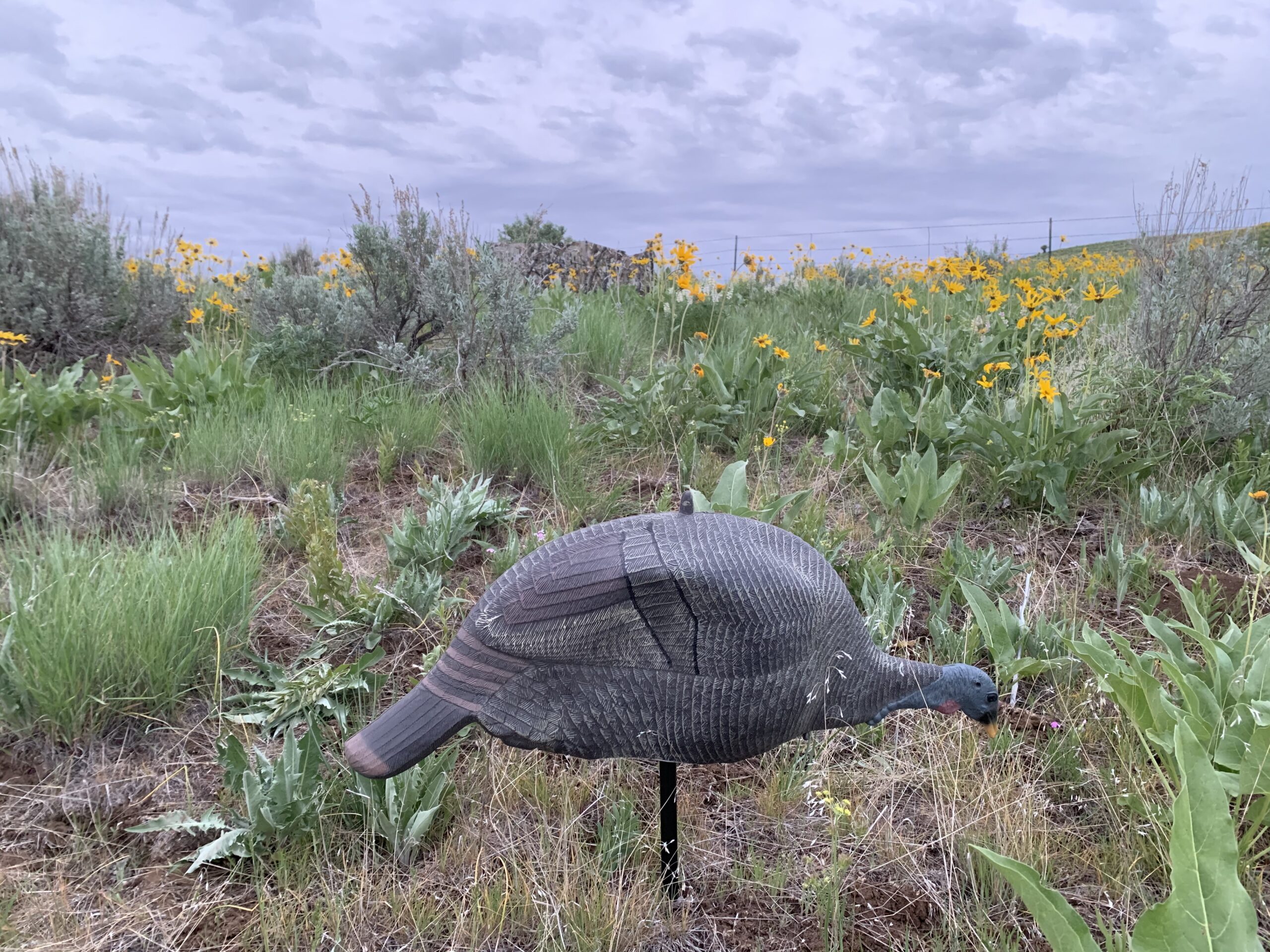
As hunters, this springtime behavior can benefit us in the pursuit of bagging a tom. Understanding the lovesick tom’s complete hatred of jakes and their ability to shelve caution in pursuit of breeding during this time of year, I’ve always used the same decoy setup when pursuing springtime turkeys. Placing a jake decoy in proximity with a hen decoy has been successful for me multiple times.
Toms set on breeding view this scenario as hostile and will arrive on the scene angry, with the sole purpose of taking out the jake. This blind hatred, combined with a tom’s reckless behavior, can tip the odds towards the hunter.
PRESEASON INTEL
Prior to the season opener, I’ll set aside some time to scout for turkey spots. My first objective during these trips is to locate the birds. Identifying tracks, droppings and feathers, plus determining the freshness of that sign will drive where I set up on opening day. If I can go a step further and get lucky enough to find a roost tree, a place where turkeys regularly rest overnight, this area will move to the top of my hunt list.
Once you find your spot, it’s time to get started. It’s well known that turkey hunters need to conceal themselves during the hunt. Dressed in camo and comfortably sitting in the shadows a short distance from a decoy setup, many turkey hunters rely on calling to get the attention of birds in the area. Subtle hen clucks and purrs will pique the interest of toms looking for love.
It’s important, however, to not overcall. I’ve tagged along with other turkey hunters who tended to wear out their slate calls. I tend to err on the other end of the calling spectrum. In my opinion, less is better.

the outdoor season,” Hovey writes. “The weather starts to warm, the days are getting longer and the animals, just like me, grow tired of being cooped up and begin to move.” (TIM E. HOVEY)
THE ROOST BOOST
A couple of years ago, a buddy invited me out on a spring turkey hunt. He had access to a huge parcel and wanted us to split up to see if we could increase our odds of filling our turkey tags. A few days before the opener, he texted me: “I found the roost tree!”
We met up 90 minutes before sunrise. Since I had never been to the property before, my buddy gave me the lay of the land. In the pitch- black he described the terrain and mentioned where he was going to set up. Just before we parted ways, he pointed east. “The roost tree is over there about 150 yards,” he said.
I switched on my red headlamp and started hiking north. Since my buddy was going to be set up on the right side of the turkey tree, near an open field, I planned to set up on a small hill to the left of the birds.
At my spot, I set up a low camo fence between me and the turkeys. Out front, I placed my hen decoy directly in view of the tree. About 10 feet away, I placed my jake decoy. In the low light, I could see the roost tree in the distance and saw a few dozen black blobs sitting on branches. As soon as the sun was up, they’d have a clear view of my setup.
About 20 minutes before shooting time, I heard my buddy calling from the meadow to my right. At first it was subtle. As the sun began to rise, his calling got way more aggressive.
He’d send out hen clucks and purrs, calling for half a minute, and after a short break, start up again. With all the racket coming from his side, I decided to stay quiet and let my cheap decoys pull the birds close.
Minutes before sunrise, a single tom flew from the roost tree and landed 30 feet from where I was set up. Less than a minute later, the entire group left the tree and completely surrounded my decoys. As they bristled and drummed near the plastic, imitation birds, I picked out the largest tom, put the shotgun bead on his head and squeezed the trigger. The male turkey fell out at about 35 yards, with the rest of the group taking flight and scattering behind me. My buddy never even saw the birds from his side of the field.

MAKING THE RIGHT CALLS
I owe a big thanks to my friend for scouting the property and especially for locating the roost tree. However, I firmly believe the reason I dropped an opening-day tom and he didn’t was the calling. Despite imitating the hens’ breeding calls perfectly, I think the overcalling tipped the odds my way.
To me, spring turkey signals the beginning of the outdoor season. The weather starts to warm, the days are getting longer and the animals, just like me, grow tired of being cooped up and begin to move. It’s the time to get out, chase some birds and do some scouting for other critters.
Just be aware that despite their reckless behavior, male turkeys are still a challenge to kill. Years ago, a friend described hunting spring gobblers to me perfectly.
“They are the dumbest, smartest birds you’ll ever hunt!” I couldn’t agree more. CS