Why Panfish Can Be An Angler’s Cure For Summertime Blues
The following appears in the August issue of California Sportsman:

As summer enters its dreaded August dog days, anglers melancholy over inactive trout and bass should turn their attention to targeting fat panfish, which you can find and tempt at virtually every Golden State freshwater fishery.(CAL KELLOGG)
By Cal Kellogg
By the time July rolls around, many California anglers begin believing the best fishing of the year is behind them.
Spring trout action has slowed as warming water pushes fish deeper into reservoirs, while bass become increasingly selective after the spawn. Long, hot afternoons and seemingly reluctant gamefish cause plenty of anglers to spend more time thinking about autumn than enjoying summer fishing. That’s a mistake.
While trout anglers probe the depths and bass fishers grind for increasingly difficult bites, another fishery is quietly entering its prime. Across the Golden State, bluegill, redear sunfish and black crappie become more active when water temperatures climb.
Whether you’re fishing a sprawling reservoir, a small foothill impoundment, a neighborhood pond or a slow-moving river, chances are excellent that quality panfish are feeding nearby. Despite all that, panfish seldom receive the respect they deserve. Many anglers think of them as children’s fish or something to catch while waiting for bass to bite. The reality is much different.
A hand-sized bluegill or a pound-class redear sunfish on ultralight tackle provides an outstanding fight, while a cooler full of crappie filets rivals any freshwater meal California has to offer.
Perhaps the greatest thing about panfish is their availability. Bluegill, redear and crappie inhabit virtually every type of freshwater fishery in California. They thrive in irrigation ponds, city lakes, farm reservoirs, major impoundments, sloughs and lazy rivers.
Waters such as Collins Lake, Folsom Lake, Rollins Lake, Clear Lake, Lake Berryessa, New Melones Reservoir, Lake Camanche, as well as countless others, support excellent panfish populations. Regardless of where you live in California, a quality panfish water is probably only a short drive away.

BLUEGILL: MEET SUMMER’S MOST AGGRESSIVE PANFISH
Bluegill are undoubtedly the foundation of California’s panfish fishery. They reproduce well, grow quickly in fertile waters and remain aggressive throughout the warmest months of the year. Unlike trout, which seek cooler temperatures, bluegill flourish in warm water and often feed with remarkable consistency from dawn until dusk.
Most anglers associate bluegill with shoreline weeds, docks and tule beds, and during the spawn that’s exactly where you’ll find them. As summer progresses, however, the biggest fish often abandon the shoreline entirely.
Modern sonar has changed the way many experienced panfish anglers approach bluegill. Rather than beating the bank all day, today’s anglers spend time searching open water for suspended schools. These fish frequently hold 15 to 25 feet below the surface over 40 or 50 feet of water while feeding on zooplankton and tiny baitfish.
I’ve seen this pattern repeatedly at Collins Lake during the heat of summer. Instead of hugging shoreline cover, large bluegill suspend beneath schools of threadfin shad. Once the fish appear on sonar, the challenge shifts from finding them to presenting a bait at exactly the right depth.
The presentation itself couldn’t be much simpler. A small drop-shot rig baited with half of a red worm or a mealworm lowered directly into the school often results in immediate action. If fish are relating to shoreline cover, however, it’s difficult to improve upon a small Aberdeen hook, a split shot and a lively worm suspended beneath a float.
Bluegill are rarely picky. If your presentation reaches feeding fish, chances are your bobber won’t stay afloat very long.

SHELLCRACKERS: THE GIANTS OF THE PANFISH WORLD
Redear sunfish, better known throughout much of the country as shellcrackers, may be California’s most underrated gamefish. Unlike bluegill, redear spend much of their lives feeding along the bottom, where they crush snails, freshwater mussels and aquatic insects using specialized throat teeth. That feeding behavior should dictate the way you fish for them.
One of the biggest mistakes redear anglers make is suspending their bait several feet above the bottom. While bluegill willingly rise to intercept a meal, these fish prefer to feed close to the lake floor. Successful shellcracker anglers understand this and keep their offerings where the fish naturally feed.
A simple drop-shot rig has become one of my favorite redear presentations. Tie a size 6 or 8 Aberdeen hook 12 to 18 inches above a light sinker and bait it with half of a jumbo red worm or a lively mealworm. Lower the rig until the sinker rests on bottom, tighten the line and simply wait. Often the bite is surprisingly subtle. Rather than jerking the rod, the fish simply swims away, loading the rod with steady pressure.
Like bluegill, giant redear don’t always remain shallow. At Collins Lake, I’ve found some of the biggest shellcrackers of the year suspended over deep water beneath schools of bait. Without electronics these fish would have remained completely unnoticed.
Many anglers never realize pound- class redear exist because they continue fishing shallow spawning areas long after the fish have moved elsewhere.
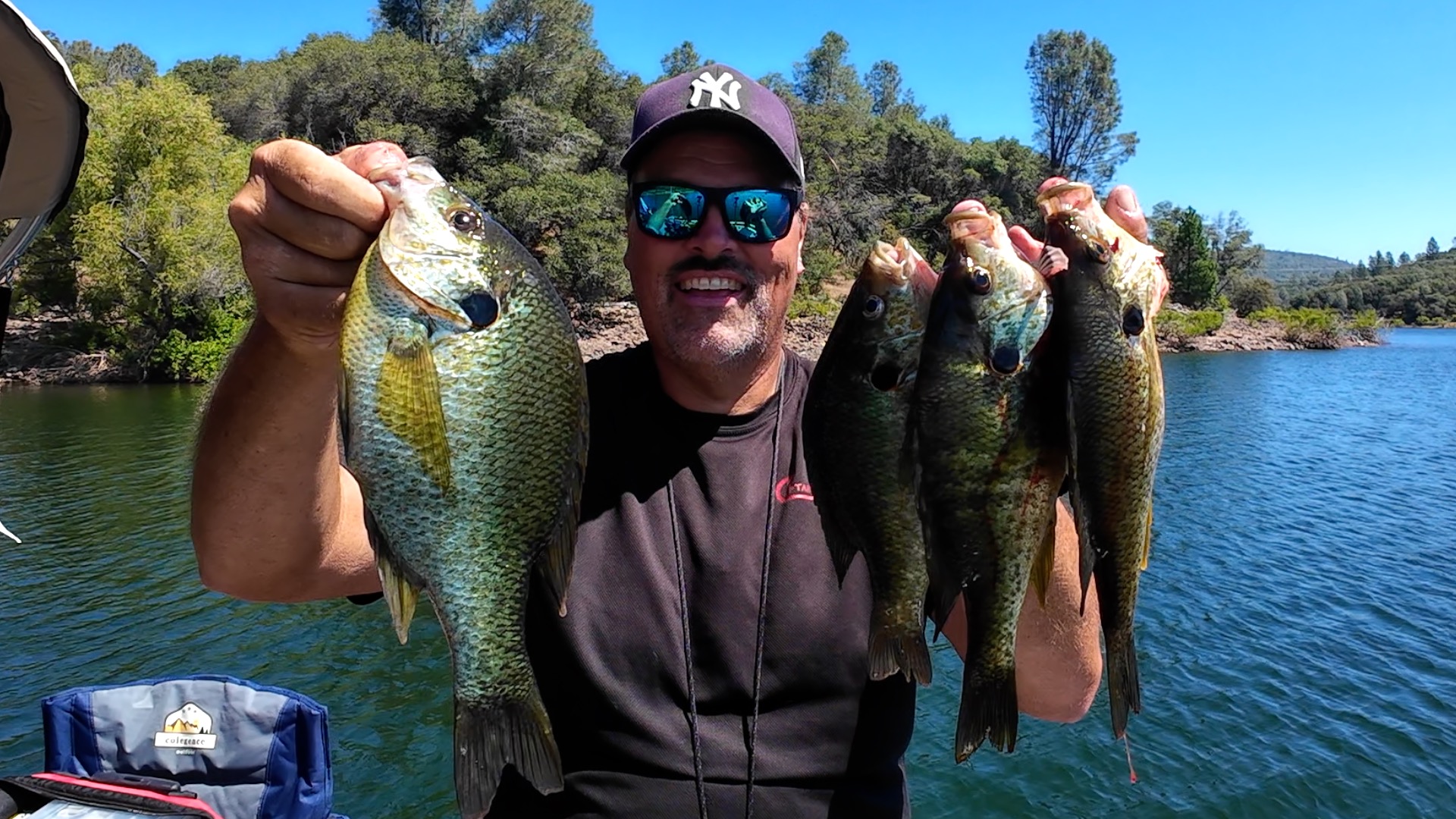

CRAPPIE: FOLLOW THE SCHOOLS
Crappie might just be the most misunderstood member of California’s panfish family. Spring spawning receives all the attention, but some of the year’s most consistent fishing actually occurs during midsummer. The key difference is location.
Rather than relating to shoreline brush, summer crappie commonly suspend around creek channels, standing timber, bridge pilings and baitfish schools. Finding them requires a willingness on an angler’s part to search open water rather than simply cast toward visible cover. Fortunately, once you locate a school, the action can be phenomenal.
As crappie are highly social fish, where there’s one, there are usually many more. Small marabou jigs remain among the finest crappie lures ever created.
White, black and chartreuse color patterns continue producing fish year after year, as the marabou fibers breathe naturally even when barely moving through the water.
The biggest mistake anglers make is retrieving too quickly. Crappie are perfectly willing to chase a lure, but slow presentations consistently produce larger fish. When you think you’re fishing slowly enough, slow down even more.
Small tube jigs, curl-tail grubs, paddle-tail plastics and live minnows also produce excellent catches. Don’t hesitate to experiment until the fish reveal their preference.
HOW ELECTRONICS CHANGED THE GAME
If there’s one piece of equipment that’s transformed modern panfishing, it’s sonar. You don’t need forward-facing sonar to become a better panfish angler, although it certainly has its place. Even a quality traditional sonar unit allows anglers to locate suspended schools that would have gone unnoticed only a decade ago.
Instead of spending hours casting at empty shoreline cover, today’s anglers can identify baitfish, suspended panfish and productive depth zones before making their first presentation.
When a school appears beneath the boat, presentations become remarkably efficient. Simply lower a bait or jig directly into the fish rather than making repeated blind casts. The result is more fish and less wasted time.
KEEP TACKLE SIMPLE
One of the greatest attractions of panfishing is its simplicity. A 6-foot ultralight spinning rod paired with a small spinning reel spooled with 4- or 6-pound monofilament handles nearly every situation you’ll encounter.
Terminal tackle is equally uncomplicated. Small Aberdeen hooks, lightweight jigheads, tiny split shot and slip floats remain the basic building blocks of successful panfish fishing. There’s no need to overcomplicate things.
Artificial lures deserve serious consideration, particularly when searching for active fish. Small white marabou jigs continue producing year after year, while tiny soft plastics have become increasingly popular. I often tip a marabou jig with a small Berkley Gulp! grub or a tiny piece of worm to combine scent with lifelike movement.
Natural bait, however, still reigns supreme. Red worms, mealworms and small pieces of nightcrawler consistently tempt bluegill, redear and crappie, regardless of where you are fishing.

fishing than panfish,” Kellogg writes. “Whether you’re fishing from shore, a kayak, a dock, a pontoon boat or a fully rigged bass boat, panfish provide
opportunities for anglers of every age and experience level.” (CAL KELLOGG)
PERFECT FAMILY FISHING
Perhaps no freshwater fish are better suited for introducing newcomers to angling than panfish. Children stay interested because bites come frequently. Parents appreciate the simple tackle and relaxed fishing. Grandparents enjoy steady action without the physical demands often associated with larger gamefish. Success breeds confidence, and confidence creates lifelong anglers.
Whether you’re fishing from shore, a kayak, a dock, a pontoon boat or a fully rigged bass boat, panfish provide opportunities for anglers of every age and experience level.
Every summer, thousands of California anglers spend countless hours chasing deep trout or reluctant bass while overlooking one of the state’s finest warmwater fisheries.
Bluegill, redear sunfish and crappie are abundant, widely distributed, aggressive and exceptional on the table. They inhabit nearly every corner of California, require relatively inexpensive tackle and provide enough action to keep even seasoned anglers smiling throughout the hottest days of the year.
The next time that summer’s heat convinces you that fishing has slowed down, consider leaving the heavy bass tackle and deep-diving trout gear at home. Instead, grab an ultralight spinfishing outfit, a handful of worms or small jigs and head out for your favorite pond, river or reservoir.
You may discover that California’s forgotten summer fishery isn’t forgotten at all. It’s simply waiting for anglers willing to appreciate just how much fun panfish can be. CS
Editor’s note: Cal Kellogg is a longtime Northern California outdoors writer. Subscribe to his YouTube channel Fish Hunt Shoot Productions at youtube.com/user/KelloggOutdoors.